Coagulation and flocculation are the two decisive steps that transform murky, unstable raw water into clear, treatable water ready for filtration and disinfection. They neutralize the electrical charges (typically −15 to −30 mV zeta potential) that keep colloidal particles — often 0.01 to 1 µm in size — in permanent suspension, then bind them into settleable floc of 0.5 to 2 mm. What nature would take days, or even decades, to achieve through gravity alone is accomplished in just 10 to 45 minutes of controlled treatment.

Success depends on two tightly coupled variables: hydraulic mixing energy and precise chemical dosing.

  • Rapid mix must deliver a velocity gradient (G value) of roughly 600–1,000 s⁻¹ over 30–60 seconds to disperse coagulant instantly.
  • Flocculation then requires a gentler G of 20–70 s⁻¹ sustained for 15–30 minutes to grow strong, settleable floc without shearing it apart.
  • Coagulant dosing — whether aluminum sulfate (10–80 mg/L), PACl (5–50 mg/L), or ferric chloride (10–100 mg/L) — must be controlled within tight tolerances, often ± 2–3 %, to stay within the optimal charge-neutralization window.
  • Polymer flocculants are dosed at far lower rates (0.05–1.0 mg/L), where even a 0.1 mg/L deviation can shift floc strength, settling velocity, and filter run time.

Underdose, and turbidity breaks through — filter runs shorten, disinfection demand rises, and finished water risks exceeding the < 0.3 NTU target. Overdose, and chemical costs climb by 15–30 %, sludge volume increases, residual aluminum or iron rises, and floc becomes fragile and shear-sensitive. The margin between optimal and inefficient is often just a few ppm — and it shifts continuously with raw water turbidity, temperature, pH, and TOC.

That is exactly where LMI metering pumps make the difference: delivering ±1 % steady-state dosing accuracy, 10,000:1 turndown on advanced models, and stable, repeatable, jar-test-validated chemical addition — hour after hour, across every shift in raw water quality. From 0.1 GPH lab-scale trials to 300+ GPH municipal feed lines, LMI pumps give operators the precision coagulation and flocculation demand, so the chemistry behind clarification always performs exactly as designed.

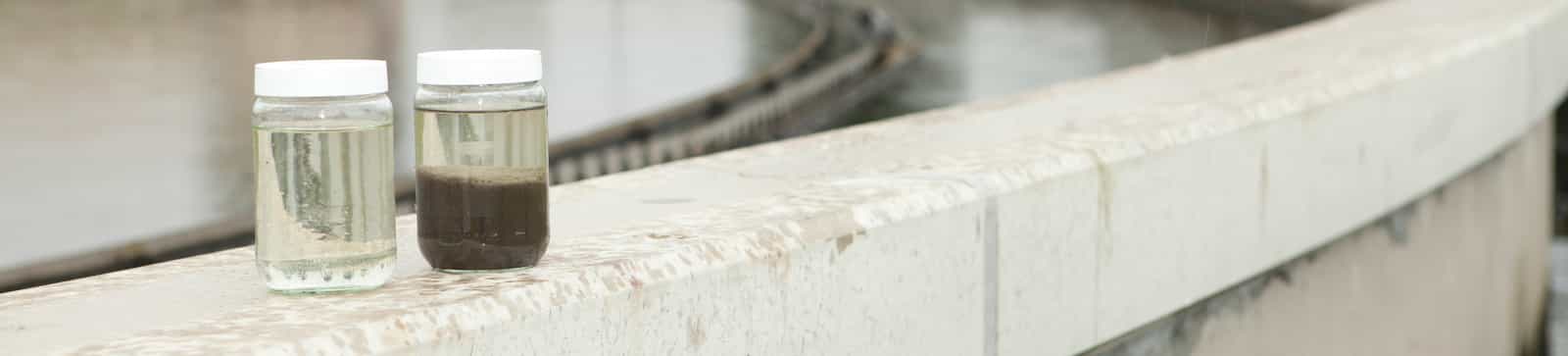
How Coagulation Works

Suspended particles in raw water are typically negatively charged. Because like charges repel, particles stay dispersed — and the water stays turbid. Coagulation neutralizes that charge by adding positively charged chemicals (coagulants), allowing the destabilized particles to clump together into microflocs.

Two families of coagulants are used:

  • Inorganic coagulants — aluminum or iron salts. Aluminum sulfate (alum) and ferric chloride are the most widely used. PACl (polyaluminum chloride) is increasingly used for its lower dose requirements and reduced sludge volumes.
  • Organic coagulants — synthetic polyelectrolytes (poly-DADMAC, polyamines). Used alone or in combination with inorganic coagulants to enhance floc formation.

How Flocculation Works

Once particles are destabilized by the coagulant, gentle mixing allows them to collide and agglomerate into larger, denser flocs that settle quickly or filter easily. Flocculant aids — typically high-molecular-weight polymers — accelerate this process by physically bridging microflocs into larger ones.

The jar test remains the industry-standard method to determine the right coagulant type and dose for any given raw water source. However, raw water quality changes — with rainfall, season, source switching, or algal blooms — so dose rates must be adjusted dynamically. Accurate, repeatable metering pumps are essential to maintain treatment performance under these changing conditions.

flocculation.jpg

The LMI Chemical Dosing Program

Chemical

Function

Typical injection point

Aluminum sulfate (alum)

Primary coagulant

Rapid mix basin inlet

Ferric chloride

Primary coagulant (low-pH source water)

Rapid mix basin inlet

Polyaluminum chloride (PACl)

Lower-dose alternative coagulant

Rapid mix basin inlet

Cationic polymer

Coagulant aid

Rapid mix basin

Anionic/non-ionic polymer

Flocculant aid

Flocculation basin entry

pH adjuster (caustic, lime, acid)

Optimize coagulation pH window

Upstream of rapid mix


Why LMI for Coagulation-Flocculation

  • ±3% steady-state accuracy — keeps coagulant dose stable as raw water conditions change.
  • 1000:1 turndown ratio on EXCEL AD9 — accommodates wide flow variations (storm events, seasonal demand).
  • 4-20 mA proportional pacing — ties coagulant dose to raw water flow or streaming current sensors.
  • High-viscosity liquid ends — engineered specifically for polymer flocculant dosing.
  • NSF 61 certification — required for drinking water chemical feed equipment.
  • Rugged NEMA 4X / IP-65 enclosures — withstand humid, chemical-laden water treatment plant environments.

Small Gains in Coagulation, Big Gains Across the Plant

A 10% improvement in coagulation control can translate into double-digit reductions in chemical consumption, sludge volume, and downstream filtration load. Few process steps deliver a higher return on optimization — yet few are as often under-engineered. Milton Roy's surface water treatment knowledge center brings together the process know-how, control strategies, and chemistry insights needed to turn coagulation from a routine dosing step into a measurable performance lever for the entire plant.